

Monte Carlo Rally 1964 - Where the Mini Magic Began.
THE
OUTSIDER’S
FINEST HOUR.
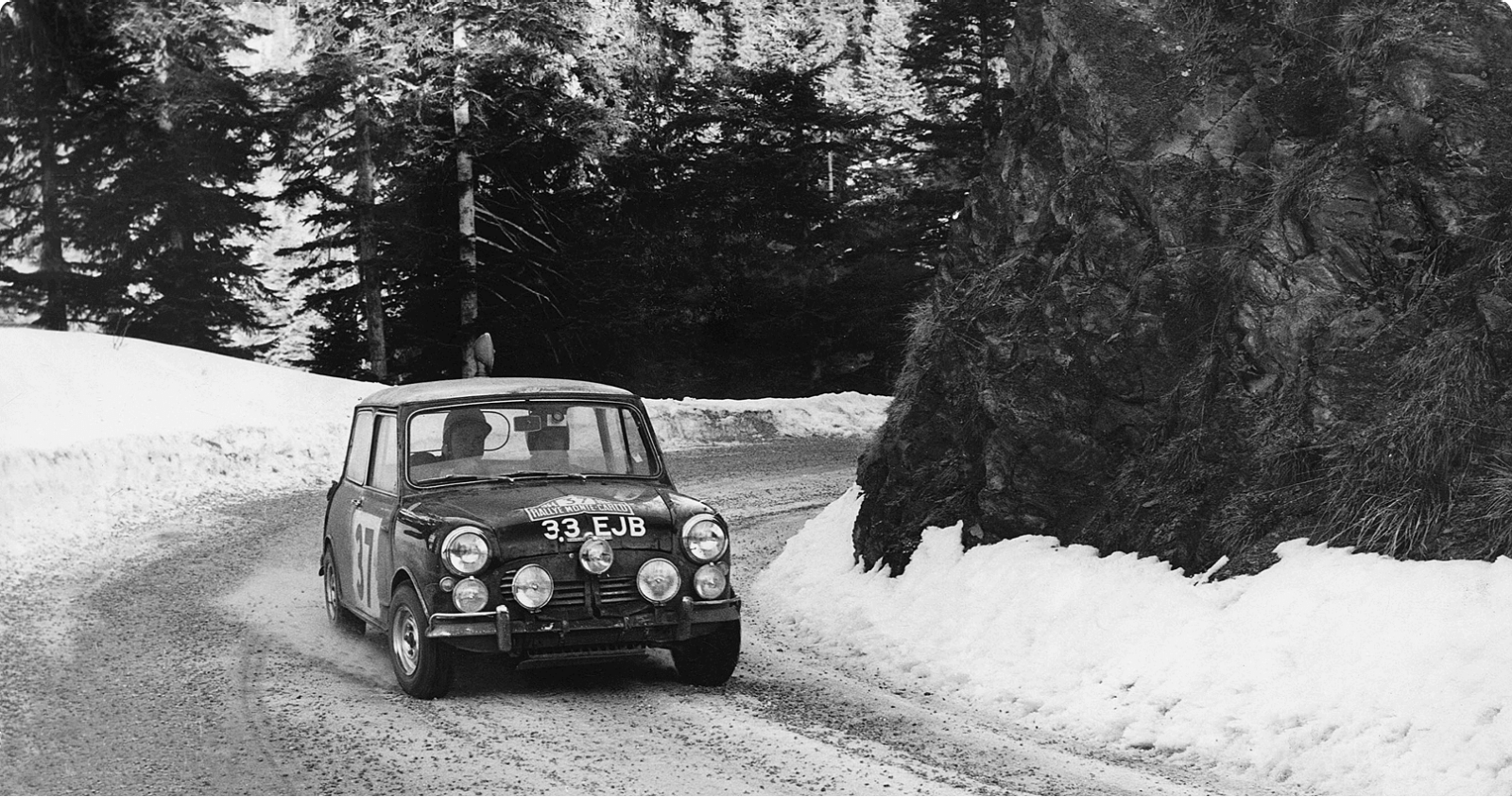
It was January 18th, 1964, and the starting signal for the 33rd Monte Carlo Rally had just been sounded across nine European cities. Every racing car united by the same goal: to be the first to reach Monaco and dominate the urban canyons just off the Côte d’Azur with lightning speed. The winding journey through the Maritime Alps would demand everything and more from their cars, with its steep slopes, tight bends, snow-and ice-covered mountain passes. There would be no questions as to why the Monte Carlo Rally was deemed one of the most difficult competitions of its kind.
The compact MINI Cooper, originally designed as an economical and affordable city speedster, should not have won. The odds were stacked against the small car given its fierce opponents. Bo Ljungfeldt, in particular, menacing behind the wheel of a powerful V8 Ford Falcon. And while race car engineer and MINI legend John Cooper had managed to increase the displacement to 1071 cm³ and tune the engine to an impressive 90 hp, MINI’s rivals still mobilized three to four times as much power. A power skillfully exploited by Ljungfeldt up until the so-called ‘Night of the Long Knives’ before which a full 65 seconds had separated him from the pack.
But then, the balance tipped.
THREE
MUSKETEERS.
ONE MINI.
UNLIMITED
OPTIMISM.
Six works cars were sent into the race that year; three finished in the top ten and ushered in the era of the ‘Three Musketeers’, consisting of Patrick Hopkirk, Timo Mäkinen, and Rauno Aaltonen. However, the immense success that caused worldwide furore had little to do with luck or chance. Only through the efforts of the engineers and drivers, the special design of the MINI, and an inexhaustible belief could history be made in the 1960s.
In line with Darwin’s theory, the little Cooper proved that it is not the most powerful but the most adaptable that comes out on top: its low weight, long wheelbase, short body transitions, and irresistible handling made it particularly agile and mitigated any performance deficit. Exceptional talent Hopkirk trained incessantly in the snow and was able to fully utilize the potential of the car, which proved similar to a go-kart in its handling.
Added to this was the team’s logistical masterstroke. So-called ‘Ice Spies’ scouted the location of critical sections on the track and radioed important information to the drivers during the race. According to Charlie, there was another decisive factor which determined the outcome: ‘Perhaps the ultimate difference was the team’s underdog spirit—a bunch of Brits, in the swinging sixties, high on optimism and the belief that they could conquer anything.’
One thing is certain; without one person in particular, none of this would have come about in the first place.

TYPICAL MINI.
BUT ALWAYS
DIFFERENT.
MINI set itself the goal of fulfilling the individual wishes of every car enthusiast. Thus, new production facilities and models such as the MINI Clubman or the MINI Convertible emerged. The focus of numerous edition models ranged from sporty and elegant to youthfully cheeky, but always maintaining the traditional sporting spirit and British flair. Over the decades, the MINI brand has reinvented itself time and again: offering increasing comfort due to high-quality materials, technical expertise, and more and more options for individualization. A MINI has been created to suit every type of surface and to accommodate every lifestyle.

BLOOD, SWEAT,
FAITH. THE
COOPER
LEGACY.
John Cooper passed on his love of customizing cars to his son, Michael. At the beginning of the 2000s, Michael founded a company specializing in tuning equipment called John Cooper Works. His first car was, unsurprisingly, a red MINI. Now, the legacy continues into its fourth generation, with Michael’s son Charlie also being a racing driver who deeply feels the same ‘entrepreneurial spirit and love of racing and motorsport’.
For Charlie, this passion is a part of his DNA: ‘I still make it a point to ring up my old man after every Formula 1 race. It’s like our post-race analysis–a tradition that’s as ingrained as Sunday roasts.’ There was a time when Charlie tried to pursue a different path, away from the Cooper career. It was a rebellious phase that ended abruptly. ‘The gravitational pull of the brand was too strong; it feels like being home after a necessary detour. I’m so glad to be back working with MINI and BMW Group, keeping the Cooper family’s authentic spirit alive and keeping one foot in motorsport’, states Charlie.
Charlie recently climbed the famous Col de Turini in a red Classic MINI with contrasting white roof, tracing the same asphalt his grandfather conquered 60 years ago with adrenaline and fighting spirit. In 2023, he also participated in the 24-hour race at the Nürburgring—one of the most challenging contests in the world–and secured a podium finish in a MINI John Cooper Works. Even today, MINI continues celebrating big firsts.

ON THE
TRACKS OF
HISTORY. THE
ELECTRIFIED
GO-KART
FEELING.
A lot has happened to the MINI Cooper over the last six decades. Its limits have been pushed and pushed again; style, vehicle technology, and functionalities have been continuously optimized. Yet the iconic features that were crucial to the Monte Carlo victory in 1964 can still be found in MINI models today: front-wheel drive, transverse-mounted engines, short body transitions, compact dimensions.
MINI remains a nimble companion that guarantees unparalleled driving pleasure and makes sportiness on four wheels suitable for everyday use. And while the charm of the original design endures, its performance has increased considerably, amplifying the characteristic go-kart feeling.
Cooper S
Engine
4-cylinder
Displacement
1071 cm'
Engine performance
51 kW (70 hp)
Torque
86 Nm
Transmission
4-speed, front-wheel drive
Acceleration (0-62 mph)
12.9 s
Top Speed
160 km/h
Wheelbase
2040 mm
Curb weight
635
Cooper S
Engine
4-cylinder
Displacement
1998 cm'
Engine performance
150 kW (204 hp)
Torque
300 Nm
Transmission
7-speed automatic, front-wheel drive
Acceleration (0-62 mph)
6.6 s
Top Speed
242 km/h
Wheelbase
2495 mm
Curb weight
1360
Now, a double relaunch of the original brings the icon into a forward-looking era: the new all-electric MINI family focuses on sustainability and transfers modern standards to the ingenious, tried-and-tested vehicle and drive concept.
For Charlie, this next step fits right in with the MINI philosophy: ‘Going all electric makes perfect sense for the brand–embracing electric technology not only aligns with the shift towards sustainability but also brings a host of benefits to the iconic MINI go-kart driving experience. My grandfather would have loved the electric revolution.’
MINI tradition—which has stood for driving fun, thrills, and the courage to be different over the course of six decades and four—lives on with Charlie as it enters a new, electric age.
Charlie, who has already tested the new generation, is particularly fond of the upcoming John Cooper Works models. To him, the cars feel agile, nimble, and remarkably well-balanced. ‘It’s the kind of driving experience that puts a grin on your face—that signature MINI grin.’
Last year, he took to the stage with Stefanie Wurst, Head of MINI, and rally legend Rauno Aaltonen to present the new electric MINI Cooper. And as he looks to the future, Charlie plans on continuing in the footsteps of his father and grandfather, cooperating to keep the unmistakable rebellious spirit alive: ‘It certainly feels like being part of a revolution, a nod to the future of racing with an electric pulse.’ It’s a Cooper with a MINI Cooper in the spotlight, who embodies ‘the joy of the ride, the thrill of competition, and the camaraderie that came with it.’
Somehow, it all sounds familiar.

See where MINI’s racing and motorsports legacy has driven itself today.
MINI Motorsports

Stay in the loop as our race team keeps outsmarting and outpacing competitors on the track.